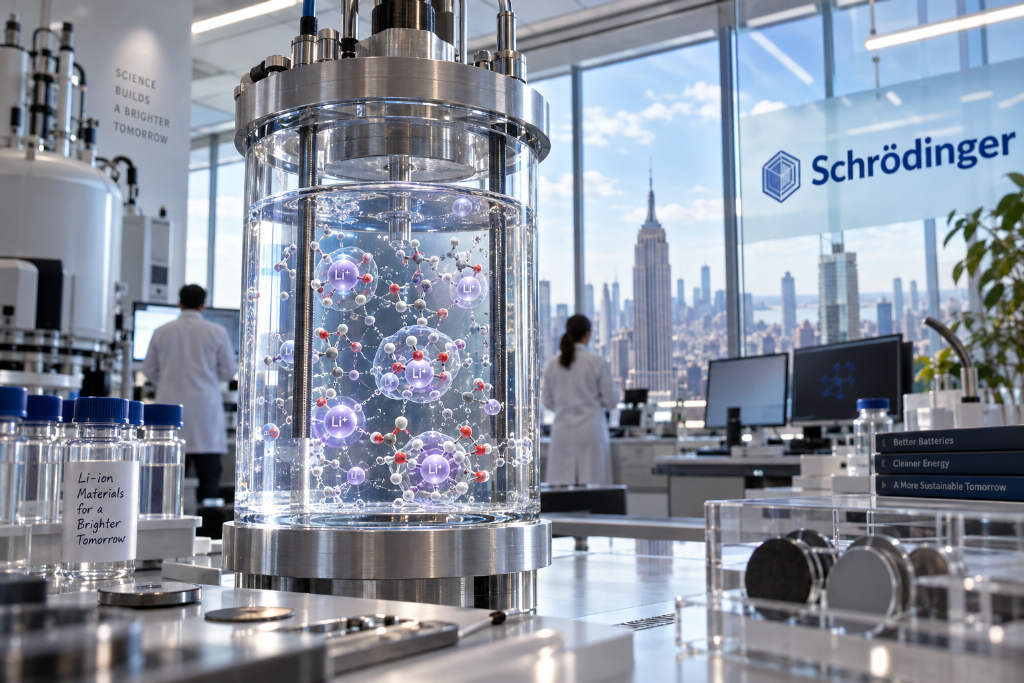
Schrödinger2026-10-16 16:01:41Schrödinger says machine learning simulations uncover atomic-level behavior in lithium-ion battery electrolytesSchrödinger has published a new lithium-ion battery study in Nature, saying its team worked with researchers from Columbia University and the New York Structural Biology Center to identify how battery electrolytes behave at the atomic level. The company said the work used its physics-based AI computing platform and machine learning force field technology to move battery research beyond trial-and-error methods toward predictive design. According to the report, the study focused on electrolyte chemistry, which affects conductivity, viscosity, salt dissociation, electrochemical stability, and the formation of the solid electrolyte interphase on the anode surface. Schrödinger said earlier efforts to model complex battery chemistry often forced researchers to choose between quantum-level accuracy and large-scale simulations. Vice President Mat Halls said the company’s machine learning force field removed that trade-off. The team reported that lithium ions in electrolyte frequently form clusters coordinated by ethylene carbonate solvent molecules, and that these clusters can exist without anions. The study said as much as 40% of lithium ions cluster in standard electrolyte conditions, with clustering becoming more common in high-salt systems. Schrödinger added that its simulation results were consistent with experimental measurements including NMR spectra, electrolyte density, viscosity, ionic conductivity, and diffusion coefficients. The company said the findings could offer data support for designing faster-charging, higher-capacity, and longer-lasting lithium-ion batteries.30